APLU Deputy Director, Prof Sope Williams, represented APLU at the Procurement Regulatory Authority of Zimbabwe’s third annual conference in October 2023, held in Harare. Zimbabwean President Emmerson Mnangagwa opened the conference and launched the country’s new electronic Government Procurement System.
Prof Williams delivered a paper focusing on the imperative for gender responsive procurement in Zimbabwe.
On 28 to 29 September 2023, APLU Director, Prof Geo Quinot, participated in the 5th Interdisciplinary Symposium on Public Procurement in Cagliari, Italy. The Symposium was hosted by the University of Rome Tor Vergata in collaboration with Sardegna Richerche (Sardigna Chircas), Sardinian Agency for Technological Research and Development. At the Symposium, Prof Quinot spoke on preferences and political economy in public procurement.
For the third year in a row, Prof Geo Quinot of APLU assisted Corruption Watch to analyse reported data pertaining to deviations, contract extensions and debarment by national and provincial public entities in South Africa. The 2023 Procurement Watch Report on Procurement Risk Trends was released on 20 September 2023 during a webinar that discussed emerging trends. The Report covers the 2022/23 financial year and draws on statutory reports submitted to and subsequently published by South Africa’s National Treasury. The 2023 Report indicates significant increase in the number of deviations reported, but at the same time, a significant decrease in the value of deviations. This suggests that deviations are occurring more frequently, but for lower-value acquisitions. On expansions, the Report indicates that while the number of contract expansions during 2022/23 remained largely the same as in prior years, the value of extensions increased significantly from about R88 billion in 2020/21 to R157 billion in 2022/23.
APLU and its associated researchers made several submissions to the Standing Committee on Finance (National Assembly) and the Select Committee on Finance (National Council of Provinces) of the Parliament of the Republic of South Africa on the Public Procurement Bill 2023 that is currently being processed by Parliament.
The National Assembly Standing Committee on Finance called for public input on the Bill to be submitted by 11 September 2023. It also held public hearings on the Bill on 12 and 13 September 2023.
APLU made a detailed submission to the Committee on the Bill, including proposals for revision of various sections in the Bill. Prof Geo Quinot appeared before the Committee on 13 September to talk to APLU’s submission. In his presentation, Quinot focused on three key objectives and three specific aspects of the text of the Bill. On objectives, Quinot noted the need to
ensure consolidation of procurement law under the Bill and called for construction procurement to be fully and exclusively regulated under the Bill and for limited secondary instruments to be issued under the Bill;
focus specifically on section 217 of the Constitution as the explicit point of departure of the Bill; and
create a clear, unambiguous framework for development through procurement in the Bill, including the use of procurement for transformation and ensuring value for money in procurement.
Quinot highlighted the following three aspects of the text of the Bill that required more attention:
Section 2: The current formulation of the objects of the Bill in section 2 is not clearly aligned to section 217 of the Constitution. Since the Constitution, and particularly section 217, is the foundation of this Bill, the objects clause should clearly state the Bill’s objects in terms of the principles set out in section 217. It is furthermore inappropriate to force the objects of the Bill through the lens of uniform treasury norms and standards as provided for in section 216 of the Constitution. This approach does not recognise the distinction made by the Constitution between treasury norms and standards under section 216 and procurement regulation under section 217.
The framework for regulating procurement operations under sections 5, 6, 7, 8, 18 and 58 is not clear enough. There are many uncertainties regarding who must do what and who can intervene in what aspect and to what extent under these provisions. Roles and responsibilities must be much more clearly and with more precision defined. In this respect, procurement institutions should be given more discretion to design operational systems appropriate within their context subject to appropriate regulatory guardrails. This requires setting out the broad contours of matters such as procurement procedures in the Bill and regulations, but allowing institutions to flesh those procedures out in a context-appropriate manner without unduly hampering discretion.
Section 17: The Bill is not sufficiently clear on the transformational dimension of procurement, including preferential procurement. The current wording leaves too many questions that may simply again lead to litigation. There is a need to tighten this provision so that it clearly states that the Minister of Finance has the power to prescribe the preferential procurement policy to be followed, in order to achieve consistency at a policy level on how preferential procurement must be approached, and leaving only implementation to procuring institutions.
APLU’s full submission can be accessed at this link. Prof Quinot’s oral submissions to the Committee can be viewed at this link.
In a second submission, APLU outlined the output of the national conversation on public procurement reform that it facilitated since February 2023. This project involved convening all stakeholders in public procurement in South Africa to discuss the future of South African public procurement in a host of in-person workshops and offline workstreams. The full submission can be accessed at this link. More details on this project, are available at this link.
APLU associated researcher, Prof Annamaria la Chimia, director of the Public Procurement Research Group at the University of Nottingham in the UK, also made independent submissions to the Parliamentary Committee on the Bill. In her submission as well as during her appearance before the Committee on 12 September, Prof La Chimia placed specific emphasis on gender-responsive procurement and what aspects of the Bill should be refined in order to promote greater participation by women in public procurement in South Africa.
Prof La Chimia’s oral submissions can be viewed at this link.
The National Council of Province’s Select Committee on Finance called for public input on the Bill to be submitted by 22 February 2024, followed by public hearings on 23 February. APLU again made submissions to the committee, highlighting remaining concerns. These focused on potential continuation of the fragmentation of South African procurement law, the need to anchor the Bill squarely in the principles of section 217(1) of the Constitution, the compatibility of the Bill with South Africa’s public finance paradigm and system of co-operative government between the three levels of government and concerns around capacity and professionalisation. The full written submission can be viewed at this link and the oral submission can be viewed at this link.
The Global Revolution series of conferences has become a firm fixture in the public procurement calendar since its inception in 1997. The first in person event post-COVID attracted well over 200 participants, included 38 sessions and hosted over 100 speakers. As always, it brought together an impressive array of public procurement experts and talent, including representatives from most of the major international institutions working in public procurement, purchasing professionals, lawyers and consultants, as well as academics.
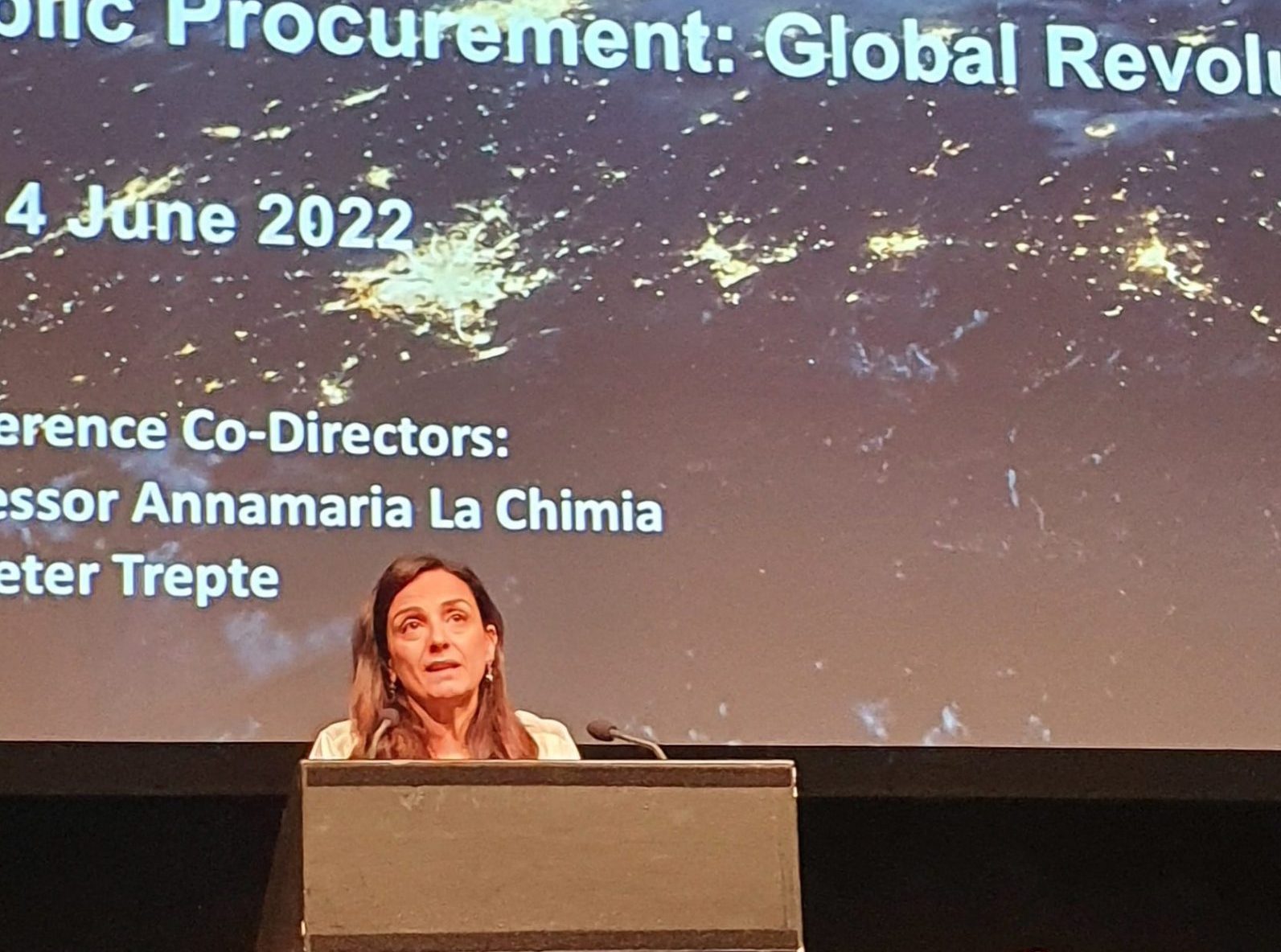
Prof Annamaria la Chimia opening the 2022 Global Revolution conference.Professors Sope Williams, Annamaria la Chimia and Geo Quinot at the Global Revolution 2022 conference.
The Public Procurement Research Group (PPRG) at the University of Nottingham, under the leadership of APLU Fellow, Prof Annamaria la Chimia, will again be hosting this major conference in 2024. The dates for the 2024 conference is 17 to 18 June and the event will again take place at the East Midlands Conference Centre in Nottingham. APLU will also again collaborate with the PPRG on the conference.
The programme can be viewed on the conference website, where delegates can also register to attend.
The South African Parliament has called for input on the Public Procurement Bill (B18-2023). The notice can be found here, and is reproduced below.
Have Your Say: Public Procurement Bill [B18 – 2023] The Standing Committee on Finance invites stakeholders and interested parties to submit written submissions on the Public Procurement Bill [B18 – 2023]
The Public Procurement Bill [B18 – 2023] aims to: regulate public procurement prescribe a framework within which preferential procurement must be implemented; and provide for matters connected therewith.
A copy of the Bill is available at www.parliament.gov.za
Submissions must be received by no later than 12:00 on Monday, 11 September 2023. Those who want to make submissions at public hearings on Tuesday, 12 and Wednesday, 13 September 2023 should specifically request this. These hearings will be conducted through Zoom. Submissions must be directed to the Committee Secretaries, Mr Allen Wicomb and Ms Teboho Sepanya, 3rd Floor, 90 Plein Street, Cape Town, 8000 or awicomb@parliament.gov.za / tsepanya@parliament.gov.za / tel. (021) 403-3759 / (021) 403-3662.
Issued by Hon. J Maswanganyi, MP, Chairperson: Standing Committee on Finance (National Assembly)
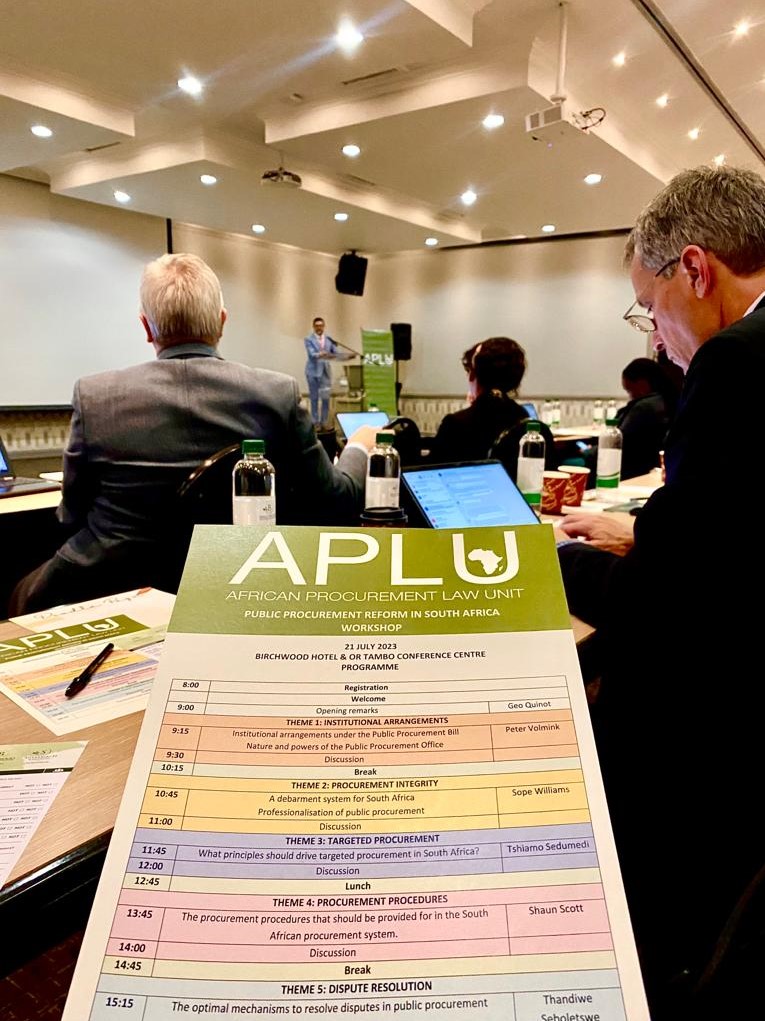
The second workshop in APLU’s project to facilitate a national conversation on procurement reform in South Africa took place at the Birchwood Hotel & OR Tambo Conference Centre on 21 July 2023. Like the first workshop in February 2023, this second workshop brought together a large range of stakeholders in South African public procurement, including public procurement practitioners, academics, representatives of government suppliers, and policy-makers.
The second workshop focused specifically on the Public Procurement Bill B18-2023 that was tabled in the South African Parliament on 30 June 2023. The Bill proposes to consolidate all procurement regulation under a single regulatory regime and introduce significant reform to the procurement system in South Africa.
Delegates engaging in debate on the Public Procurement Bill.
Delegates deliberated on a range of topics under the Bill, organised under five core themes:
THEME 1:
INSTITUTIONAL ARRANGEMENTS
Topics
Institutional arrangements under the Public Procurement Bill
Nature and powers of the Public Procurement Office
South Africa’s public procurement regime, established in the context of public sector reform initiatives of the late 1990s and early 2000s, requires reform. The drafting process for new public procurement legislation has been a long and winding one, and much of it has taken place beyond public scrutiny. In 2022 a revised version of the 2020 Public Procurement Bill was introduced into the National Economic Development and Labour Council (Nedlac). The deliberations in Nedlac were attended, at the request of business and labour, by a small number of individuals and organisations with expertise in public procurement. At the request of Nedlac social partners (business and labour), this group of individuals and organisations were formalised to provide technical expertise on the Bill and styled as a Joint Strategic Resource (JSR), coordinated by the Public Affairs Research Institute (PARI), and including the African Procurement Law Unit (APLU), the Wits School of Construction Economics and Management, and Corruption Watch. This paper explains the strategic procurement paradigm that underpins the JSR Draft of the Bill. We argue that the JSR Bill demonstrates that strategic procurement is appropriate to the South African context for adoption and implementation as the key concept in a comprehensive public procurement statute.
We worked for a statute that would provide for public procurement which is developmental in economic nature and outlook, aspiring to expand the productive base of the economy and to support innovation and investment. This meant that preferential procurement policies (including local content) were part and parcel of the statute. The legal architecture of the National Treasury Public Procurement Bill of 2022 contains little hope of moving away from a repetition of the lack of success of the earlier generations of regulatory instruments in this field. We argue this is not so much the fault of OCPO drafting, but rather of the fundamental choice not to exercise through Parliament the policy making power of the state to adopt, promulgate, and enforce a comprehensive public procurement statute. The Bill should itself contain clear and accessible substantive policy choices in this area and not delegate and allow for such decisions to be taken (or fail to be taken) in the sub-units of National Treasury.
Comments Off on First workshop on a national conversation on procurement reform in South Africa
The African Procurement Law Unit (APLU) initiated a national conversation on public procurement reform in South Africa during a two-day gathering in Johannesburg from 27 to 28 February 2023.
The initiative is a response to the call of the Zondo Commission of Inquiry into State Capture which noted that “any serious attempt to address the problems which beset public procurement must go well beyond state capture … the process of reform requires a coherent and comprehensive plan of action which needs to bring the public and private sectors together in a joint initiative to restore proper standards and discipline within the procurement system.”
The event drew over 120 delegates from the South African public procurement/supply chain management community to discuss all aspects of public procurement with the aim of framing a vision for the future of public procurement in South Africa. Delegates came from all levels of government, including key national departments such as Treasury; Justice and Constitutional Development; Public Works and Infrastructure; Trade, Industry and Competition and Defence as well as from public bodies such as the NRF; Public Service Commission; SARS; Competition Commission and SANRAL. Suppliers to the government as well as supplier organisations such as Consulting Engineers South Africa and the Steel and Engineering Industries Federation of Southern Africa were present. Participating NGOs included Corruption Watch; the Legal Resources Centre; Amabhungane; Open Ownership, OUTA and the Public Service Accountability Monitor as well as some of South Africa’s leading procurement academics and lawyers.
The topics discussed ranged from the forthcoming public procurement legislation for South Africa, how best to deal with the restriction of poor performing and corrupt suppliers to government, the liability of public officials for procurement failures, the need for the state to buy local goods in order to support local industrial development, how to accelerate transformation via public procurement practices, increased use of technology to improve efficiencies in procurement and to reduce abuse and how best to deal with challenges to tender awards.
Prof Geo Quinot, APLU director and professor of law at SU, noted in his opening remarks that “public procurement is the backbone of service delivery in our country, of making real the aspirations of our constitution, of driving economic development. By coming together, all of us can strengthen that backbone to the benefit of everyone who live in our country.” Click here to listen to the full opening remarks.
Smaller workstreams at the workshop
The issues raised during the plenary engagements were categorised under five themes and discussed in more detail by smaller working groups. The themes are institutional arrangements; procurement integrity; targeted procurement; procedures & efficiency; and dispute resolution. The South African public procurement community intends to contribute to the ongoing reforms of the public procurement system and following the two-day workshop, the national conversation continues by way of workstreams where delegates will continue to explore the themes raised in the working groups. For each theme, an issue paper will be collaboratively developed to set out inter alia the nature of the issue, its role in the procurement system, possible ways in which it could be regulated, suggested operating procedures and standard documents, and the skills required to manage the issue. The issue papers will include case studies, from South Africa and beyond, on how the issue has been successfully addressed. These issue papers will be discussed at further gatherings, including another national workshop in June. The outcomes can feed into the public consultation processes that will accompany new procurement legislation, and the crafting of regulations and other implementation instruments under a new procurement statute, once passed. Generally, the initiative aims to assist all stakeholders in improving procurement practice – from the regulators tasked with designing and overseeing the procurement system; to the leadership of organs of state in using procurement as a strategic tool; to procurement officials in their daily acquisition functions; to businesses wanting to supply goods and services to the state.
The South African procurement community believes that by bringing together the experiences of officials awarding tenders, of enterprises selling to the state, of regulators monitoring the spending of public money, of NGOs focusing on the impact of procurement on civil society and of academics researching and training on all aspects of public procurement, the South African society can collaboratively construct a fit-for-purpose procurement system that can deliver best value for money.
Listen to the closing remarks by Prof Quinot at the end of the first workshop at this link.