Associate Professor Tecle Hagos Bahta

Tecle Hagos Bahta

Tecle Hagos Bahta

Tecle Hagos Bahta (LL.B (AAU (2002)), LL.M in Comparative and European Law (2006), University of Ghent , Belgium, PhD candidate in International Investment arbitration , University of Warwick, UK), is an associate professor of law at the University of Mekelle, Department of Law in Ethiopia. He is also currently teaching at the University of Botswana, Department of Law. He has published several articles in national and international journals in the laws of Arbitration and ADR, Construction law, and Public Procurement laws and regulations. His publications in public procurement laws and regulations in particular are:


  • The Regulatory Framework for Public Procurement in Ethiopia in Public Procurement Regulation  in Africa, (eds) Geo Quinot and Sue Arrowsmith, CUP, 2013
  • Complaints Review and Remedies under the Federal Government Procurement Law in Ethiopia, 2012 (21) PPLR, Issue 5, 188-203
  • Adjudication and Arbitrability of Government Construction Disputes, 3 Mizan Law Review 1-32 (2009)

Bolton trains local administrators

In March 2013 Professor Phoebe Bolton offered a one-day training course to municipal officials of the Saldanha Bay Municipality. The training focused on the following aspects:

  • rules for the acquisition of goods and services and deviations from the prescribed rules;
  • the roles and functions of bid committees;
  • rules for the determination of responsiveness;
  • rules on obtaining clarifications from bidders;
  • rules on the disqualification of bidders;
  • the submission of tax clearance certificates;
  • the supervisory role of the Municipal Manager in the procurement process;
  • the receipt of complaints and appeals from aggrieved bidders; and
  • the application of case law

More procurement reforms on the way in South Africa

In his budget speech in Parliament on 27 February 2013, Finance Minister Pravin Gordhan indicated further reforms to the public procurement system in South Africa with a particular focus on curbing corruption. He said:

Minister Gordhan delivering the 2013 budget speech

Minister Gordhan delivering the 2013 budget speech

Procurement and combating corruption

Mister Speaker, last year I said to this House that we will continually endeavour to increase the value which government receives for the money it spends.

Let me be frank. This is a difficult task with too many points of resistance! However, we have registered some progress. In the present system, procurement transactions take place at too many localities and the contracts are short term. Consequently there are hundreds of thousands of transactions from a multitude of centres. There is very little visibility of all these transactions. While our ablest civil servants have had great difficulty in optimising procurement, it has yielded rich pickings for those who seek to exploit it. There are also too many people who have a stake in keeping the system the way it is. Our solutions, hitherto, have not matched the size and complexity of the challenge. As much as I want, I cannot simply wave a magic wand to make these problems disappear. This is going to take a special effort from all of us in Government, assisted by people in business and broader society. And it will take time. But we are determined to make progress.

The process for setting up the Chief Procurement Office in the National Treasury has begun in earnest and I shall soon be able to announce the name of a Chief Procurement Officer. A project team seconded from state agencies and the private sector has identified four main streams of work, involving immediate remedial actions, improving the current system, standardising the procurement of critical items across all government and the long-term modernisation of the entire system.

Among the first initiatives of the CPO will be to enhance the existing system of price referencing. This will set fair value prices for certain goods and services. Secondly, it will pilot procurement transformation programmes in the Departments of Health and Public Works, nationally and in the provinces.

National Treasury is currently scrutinising 76 business entities with contracts worth R8.4 billion which we believe have infringed the procurement rules, while SARS is currently auditing more than 300 business entities and scrutinising another 700 entities. The value of these contracts is estimated at over R10 billion. So far 216 cases have been finalised resulting in assessments amounting to over R480 million being raised. The Financial Intelligence Centre has referred over R6.5 billion for investigation linked to corrupt activities.

I fully support Minister Sisulu’s call for appropriate curbs on officials doing business with government. I will complement her initiative by aligning the Public Finance Management Act with the provisions of the Public Service Act.”

These remarks confirm the impression created by the draft Treasury Regulations published late last year, which, in the part dealing with supply chain management, seem to suggest a move back to a more central controlled procurement approach.

Dominic N Dagbanja

Dr Dominic Dagbanja

Prof Dominic Dagbanja

Prof Dominic N. Dagbanja is Associate Professor at the Curtin University Law School, Bentley, Perth, Western Australia. He previously worked at the University of Western Australia Law School as a Senior Lecturer, University of Manchester Law School as a Research Associate and was Lecturer in Law at Ghana Institute of Management and Public Administration where he taught Contract Management and Legal Environment for Business. He practised law with the corporate and commercial law firm of Bentsi-Enchill, Letsa & Ankomah, in Accra, Ghana and  was a Senior Legal Officer at the Public Procurement Authority of Ghana. He has published extensively on international investment law and public procurement law in peer-reviewed journals and edited collections. He is also the author of The Law of Public Procurement in Ghana (Lambert Academic Publishing 2011). Dr Dagbanja’s article, The Intersection of Public Procurement Law and Policy and International Investment Law, won the United Nations Conference on Trade and Development-Society of International Economic Law Award for Research in Investment and Development in 2020.

Dr Kingsley Tochukwu Udeh

Kingsley Udeh has a Doctor of Laws (LLD) degree from Stellenbosch University. His doctoral research was on Comparative Study of the Effectiveness of Bidder Remedies in South Africa and Nigeria (the full dissertation can be found here.). His LLM, from the University of Nottingham, covered modules that included: Public Procurement in the EU and International Trade Law, Public Procurement Law, International Trade Finance, World Trading System, International Investment Law, and International Disputes Settlement. The Master’s dissertation, on critical appraisal of Kenya bidder remedies system, was awarded a distinction.

He is a qualified legal practitioner, Notary Public, and consultant, with over 12 years’ experience in providing consultancy services in public procurement and public finance management regulation to national and international organisations, including UNICEF (and other UN agencies) and DFID, as Lead Procurement Consultant. In 2017, Enugu State Government appointed him as the Senior Special Assistant to the State Governor on Development Aid Coordination and Mobilization.  He is a former lecturer with Baze University, Abuja, Nigeria; and the Nigerian Law School. He has been an active member of the African Procurement Law Unit of Stellenbosch University since its creation in 2012; and serves in the editorial committee of the African Public Procurement Law Journal. Dr Udeh has several publications in international scholarly journals and in relevant academic books.

In 2023, Dr Udeh was appointed as Attorney General and Commissioner for Justice, Enugu State, Nigeria.

Dr Allison Anthony

Following the successful completion of her pioneering LLM study in the regulation of construction procurement in the public sector, Allison registered in 2016 for a doctoral study to continue her research in this field. In her doctoral dissertation, Allison asked whether a relational understanding of construction procurement in South Africa assists in formulating regulation for this area of public procurement. She successfully completed her study in 2017 and was awarded the doctoral degree in 2018. Allison is currently a senior lecturer in the University of South Africa School of Law. In 2021, she published the first dedicated academic work on construction procurement law in South Africa with Juta & Co.

PAST PROJECTS

LLM PROJECT: CONSTRUCTION PROCUREMENT IN SOUTH AFRICA

Student: Ms A Anthony

Supervisor: Prof P Bolton

University: Stellenbosch University

Status: Completed in 2013, the thesis is available here >>

LLD PROJECT: THE LEGAL REGULATION OF CONSTRUCTION PROCUREMENT IN SOUTH AFRICA AS A RELATIONAL CONSTRUCT

Student: Ms A Anthony

Supervisor: Prof P Bolton & Prof G Quinot

University: Stellenbosch University

Status: Completed in 2017, the dissertation is available here >>

New book on African public procurement regulation

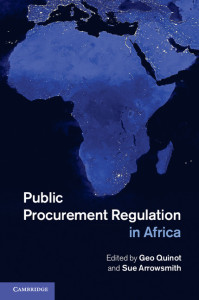
In January Cambridge University Press published Public Procurement Regulation in Africa edited by Prof Geo Quinot (Stellenbosch University) and Prof Sue Arrowsmith (University of Nottingham). The book aims to address the shortage of scholarship in the area of public procurement regulation on the African continent and to promote future research. In the book the law governing public procurement in a number of African systems is analysed and key themes relevant to all African states are looked at. Part I discusses the regulatory regimes of nine African systems using a common framework, providing both a focused view of these African systems and an accessible comparative perspective. In Part II, key regulatory issues in public procurement that are particularly relevant in the African context are assessed through a comparative approach. The chapters consider the influence of international regulatory regimes (particularly the UNCITRAL Model Law on procurement) on African systems and provide insights into the way public procurement regulation is approached in Africa. Apart from contributions by Quinot, the book also contains chapters written by Prof Phoebe Bolton and Dr Sope Williams-Elegbe, both of Stellenbosch University. The book is one of the first major outcomes of the work done by the African Public Procurement Regulation Research Unit, established at Stellenbosch University in 2012.

More information >>

Public Procurement Regulation in Africa

Edited by: Geo Quinot & Sue Arrowsmith

Cambridge University Press (2013)

African Procurement Book Cover Public procurement regulation in Africa is not widely researched. To address the shortage of scholarship in this area and to promote future research, this book analyses the law governing public procurement in a number of African systems and looks at key themes relevant to all African states. Part I discusses the regulatory regimes of nine African systems using a common framework, providing both a focused view of these African systems and an accessible comparative perspective. In Part II, key regulatory issues in public procurement that are particularly relevant in the African context are assessed through a comparative approach. The chapters consider the influence of international regulatory regimes (particularly the UNCITRAL Model Law on procurement) on African systems and provide insights into the way public procurement regulation is approached in Africa.

More information: For those in sub-Subharan Africa>> OR outside sub-Saharan Africa>>

Draft Treasury Regulations published

The South African National Treasury has published new draft Treasury Regulations under the Public Finance Management Act 1 of 1999 to replace the current 2005 Treasury Regulations. Included in the new draft is an entire new section (Part 7) dealing with Supply Chain Management and setting out in significant more detail than the current Treasury Regulations the legal rules for public procurement. The draft aims to give more explicit content to the five constitutional principles governing public procurement, namely fairness, equity, transparency, competitiveness and cost-effectiveness. Noteworthy developments are strict rules about tender awards to persons in the service of the state, mandatory participation in transversal term contracts arranged by the relevant treasury and extensive formal reporting requirements of all procurement transactions.

The draft regulations can be found here >>

APPRRU’s comments on these regulations are available here>>