Dutch researchers Professor Frank van Ommeren and Mr Niels Jak hosted by the Socio-Economic Rights and Administrative Justice Research Group (SERAJ) and the African Public Procurement Regulatory Research Unit (APPRRU)
Two Dutch researchers, Professor Frank Van Ommeren and Mr Niels Jak, have spent a number of weeks in November at Stellenbosch University as guests of SERAJ and APPRRU conducting comparative research into public accountability, governance and semi-public organisations.

Prof Van Ommeren presents his lecture.
During their stay in South Africa both academics presented informative seminars to members of SERAJ and APPRRU. On 7 November 2012 Professor Frank van Ommeren presented a lecture on law and governance in the public domain. The lecture canvassed the law and governance approach as it applies in the Netherlands with the aim of facilitating a comparative discussion. In terms of this approach the law becomes instrumental to the governance of entities performing public functions. Professor Van Ommeren illustrated that public functions are often performed by a wide array of actors which might not necessarily be subject to constitutional and administrative law (such as semi-public organisations, civil society or, in some instances, even private commercial enterprises). If left unchecked, this might lead to an accountability vacuum. This has led to the development of the principles of good governance in the Netherlands. These are principles that would apply to all actions of entities performing public functions, regardless of the public or private nature of such actions. Professor Van Ommeren indicated that these principles can be utilised as a mechanism to promote greater applicability of public law norms, accountability and democratic legitimacy.
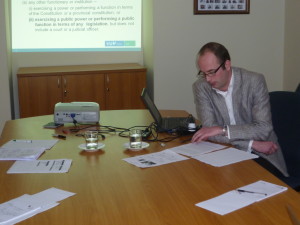
Mr Jak presenting.
On the same date Niels Jak presented a lecture on his comparative research on the regulation of semi-public organisations in the Netherlands and South Africa. These entities could be described as private bodies exercising a public function (similar to utility providers) and other entities institutionally connected to the state (such as state-owned enterprises). The lecture focussed on the complex regulatory challenges posed by these entities, particularly issues related to the infiltration of public law norms into the private sphere. Mr Jak examined the regulatory regimes governing these organisations in both countries and drew a number of important conclusions. In particular, he argued that, compared to the Dutch system, the South African regulatory system allows for the greater applicability of public law standards to semi-private organisations.
Professor Van Ommeren presented another seminar on 14 November 2012 on the public-private law divide. The contentious issue of the distinction between public law and private law, as well as the consequences of such a distinction, have been widely debated for decades. Professor Van Ommeren presented the public-private law divide as multifunctional (the divide may be used for multiple purposes) and context dependent (the purpose of the divide may change depending of the specific context). In order to illustrate this point, Professor Van Ommeren discussed the role of the public-private divide in two crucial aspects of Dutch law, namely its use in judicial protection mechanisms (essentially the procedural jurisdictional limits of the Dutch Administrative Court) and the applicability of substantive law standards (either public or private). The seminar was based on Prof Van Ommeren’s published work in this field, including his article with Gerdy Jurgens published in 2012 in the Cambridge Law Journal (Gerdy Jurgens & Frank Van Ommeren “The Public-Private Divide in English and Dutch Law: A Multifunctional and Context-Dependant Divide” (2012) 71 Cambridge Law Journal 172–199).
Professor Van Ommeren is a professor of Constitutional and Administrative Law at the VU University Amsterdam and co-director of the VU University Amsterdam Centre for Law and Governance’s programme on “Balancing Public and Private Interests”, where his research is focussed on government and governance. Professor Van Ommeren has also amassed considerable expertise as a former senior legal counsel at the Department of Legislation at the Dutch Ministry of Justice. He has a special interest in the public-private divide, government and different kinds of governance, such as regulation with limited licenses, governmental contracts (voluntary agreements) and self-regulation. He is widely published in these fields. Niels Jak is a lecturer and PhD candidate at the Vrije University of Amsterdam, where he teaches Administrative Law and Government Corporation Law. He conducts research under the auspices of the VU University Amsterdam Centre for Law and Governance’s programme on “Balancing Public and Private Interests”, with a particular focus on the regulation of semi-public organisations.
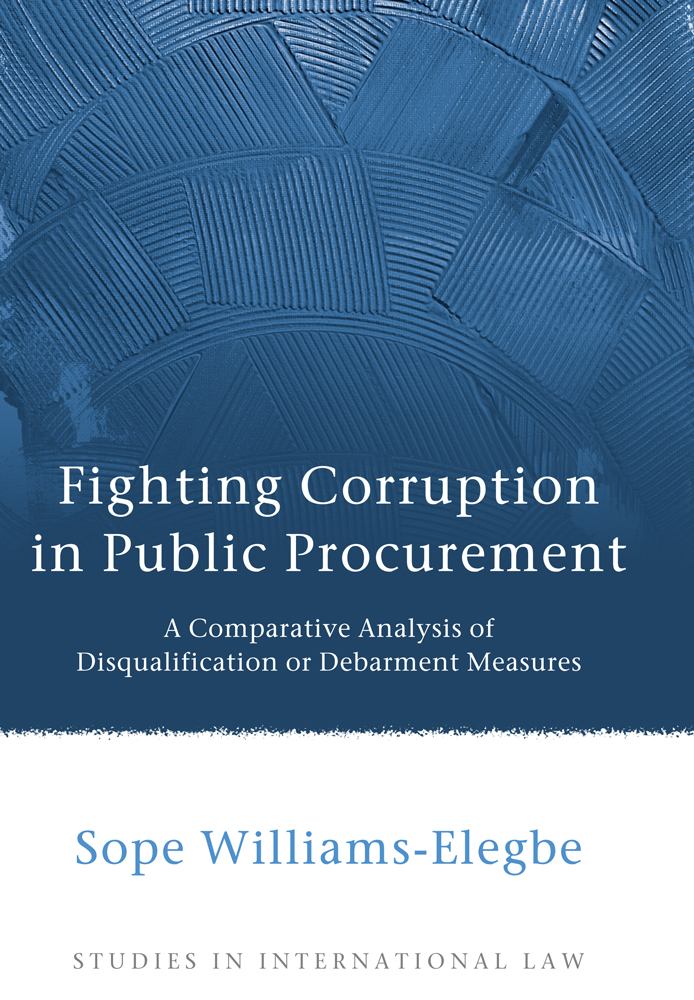 Anti-corruption measures have firmly taken centre stage in the development agenda of international organisations as well as in developed and developing countries. One area in which corruption manifests itself is in public procurement and, as a result, States have adopted various measures to prevent and curb corruption in public procurement. One such mechanism for dealing with procurement corruption is to debar or disqualify corrupt suppliers from bidding for or otherwise obtaining government contracts.